---
title: Understand Violet Benchmarks and badges in provider search results
description: What Violet Benchmarks, the Awareness, Proficiency, and Excellence levels, and Violet Verified Organization status mean when choosing a referral.
---
[Skip to content](https://help.joinviolet.com/care-coordinators/understand-benchmarks-in-provider-search-results#main-content)
[Request support](https://help.joinviolet.com/kb-tickets/new?hsLang=en)
[](https://help.joinviolet.com?hsLang=en)
- [Home](https://help.joinviolet.com/)
- Provider & Care Teams
Show submenu for Provider & Care Teams
- [Demo](https://help.joinviolet.com/general/about)
- [Details](https://help.joinviolet.com/providers-care-teams)
- Care Coordination
Show submenu for Care Coordination
- [Demo](https://help.joinviolet.com/provider-organizations/verified-inclusive-org-0)
- [Details](https://help.joinviolet.com/care-coordinators)
- Provider Organization Admins
Show submenu for Provider Organization Admins
- [Demo](https://help.joinviolet.com/provider-organizations/verified-inclusive-org-0-2)
- [Details](https://help.joinviolet.com/provider-organizations)
- Health Plans & Network Managers
Show submenu for Health Plans & Network Managers
- [Demo](https://help.joinviolet.com/provider-organizations/verified-inclusive-org-0-0)
- [Details](https://help.joinviolet.com/health-plans-provider-network-managers)
Open main navigation
Close main navigation
- [Home](https://help.joinviolet.com/)
- Provider & Care Teams
Show submenu for Provider & Care Teams
- [Demo](https://help.joinviolet.com/general/about)
- [Details](https://help.joinviolet.com/providers-care-teams)
- Care Coordination
Show submenu for Care Coordination
- [Demo](https://help.joinviolet.com/provider-organizations/verified-inclusive-org-0)
- [Details](https://help.joinviolet.com/care-coordinators)
- Provider Organization Admins
Show submenu for Provider Organization Admins
- [Demo](https://help.joinviolet.com/provider-organizations/verified-inclusive-org-0-2)
- [Details](https://help.joinviolet.com/provider-organizations)
- Health Plans & Network Managers
Show submenu for Health Plans & Network Managers
- [Demo](https://help.joinviolet.com/provider-organizations/verified-inclusive-org-0-0)
- [Details](https://help.joinviolet.com/health-plans-provider-network-managers)
- [Request support](https://help.joinviolet.com/kb-tickets/new)
How can we help you?
- There are no suggestions because the search field is empty.
1. [Violet Help Center](https://help.joinviolet.com/?hsLang=en)
2. [Care Coordinators](https://help.joinviolet.com/care-coordinators?hsLang=en)
3. [Provider Search](https://help.joinviolet.com/care-coordinators?hsLang=en#provider-search)
# Understand Violet Benchmarks and badges in provider search results
## What Benchmark levels, communities, and verification statuses mean for referrals
When you search for providers in Violet's **Care Coordination** tool, results include more than contact details — they show verified signals of each provider's cultural competence. This article explains what those signals mean so you can make confident, appropriate referrals.
### What are Violet Benchmarks?
Violet Benchmarks are verified measures of a clinician's cultural competence in caring for specific communities. Providers earn Benchmarks by completing their Violet profile — sharing their education, training, work experience, identity, and languages — and by completing relevant clinical education. Violet then benchmarks them for each community.
Benchmarks are awarded at three levels, from foundational to advanced:
- **Awareness** — foundational knowledge and commitment to serving the community.
- **Proficiency** — demonstrated experience and applied skills caring for the community.
- **Excellence** — extensive, sustained experience and leadership in caring for the community.
### Which communities do Benchmarks cover?
In Care Coordination search you can filter providers by verified competence for these communities:
- **BIPOC** — Black, Indigenous, People of Color
- **LGBQ** — Lesbian, Gay, Bisexual, Queer
- **TGNC** — Transgender & Gender Non-Conforming
- **Neurodivergent**
- **Rural**
- **Veterans**
### Reading the search results
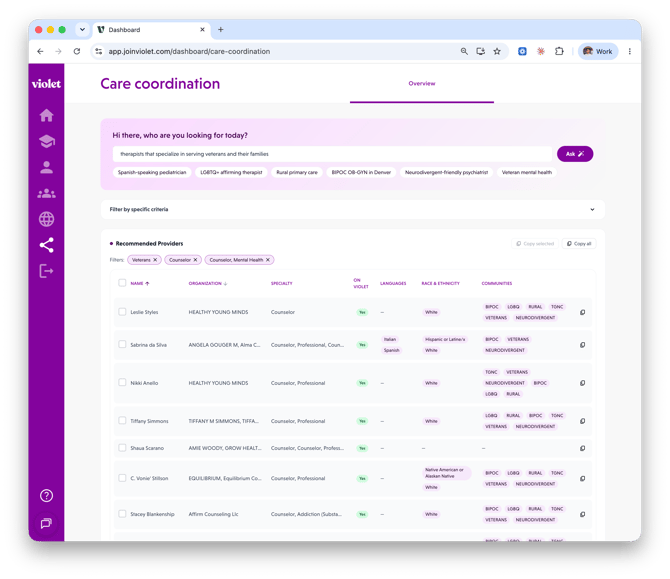
Each row in the **Recommended Providers** table includes:
- **Name**, **Organization**, and **Specialty** — the provider's clinical identity.
- **On Violet** — whether the provider has an active Violet account. Providers on Violet have self-reported profiles and up-to-date benchmarking; providers not on Violet may still appear with inferred data from public and network sources.
- **Languages** — languages the provider speaks with patients.
- **Race & Ethnicity** — as self-reported by the provider, when available. Some patients prefer racially or ethnically concordant care; this column helps you honor that preference.
- **Communities** — the communities for which the provider holds earned Violet Benchmarks (for example, BIPOC, TGNC, LGBTQ+).
### What the Status filters mean
In the **Filter by specific criteria** panel, the **Status** section lets you narrow results by how connected a provider is to Violet:
- **Provider on Violet** — the individual provider has an active Violet account, so their profile and Benchmarks come from verified, self-reported data.
- **Organization on Violet** — the provider works at an organization that partners with Violet, meaning their care team has access to Violet's education and benchmarking.
- **Violet Verified Organization** — the organization has met Violet's verification criteria for inclusive care, including having a sufficient share of its clinical team benchmarked. This is the strongest organization-level signal of commitment to person-centered care.
### Putting it together: choosing a referral
1. Start from the patient's clinical need (specialty), language, and location.
2. Add the community filter(s) that match the patient's identity — for example, TGNC for a transgender patient seeking gender-affirming care.
3. Prefer providers whose **Communities** column shows an earned Benchmark for that community, and use **Violet Verified Organization** when the patient would benefit from an inclusive environment beyond a single clinician.
4. Copy the shortlist to your clipboard and share it through your normal referral workflow.
### Related articles
- Finding inclusive providers for referrals with Care Coordination search
- Getting set up: onboarding and education for care coordination teams
- [Overview](https://help.joinviolet.com/overview?hsLang=en#main-content)
- [Demo](https://help.joinviolet.com/overview?hsLang=en#demo)
- [Details](https://help.joinviolet.com/overview?hsLang=en#details)
- [Providers & Care Teams](https://help.joinviolet.com/providers-care-teams?hsLang=en#main-content)
- [Profile & Benchmarks](https://help.joinviolet.com/providers-care-teams?hsLang=en#profile-benchmarks)
- [CE/CME & Certificates](https://help.joinviolet.com/providers-care-teams?hsLang=en#ce-cme-certificates)
- [Education](https://help.joinviolet.com/providers-care-teams?hsLang=en#education)
- [Care Coordinators](https://help.joinviolet.com/care-coordinators?hsLang=en#main-content)
- [Demo](https://help.joinviolet.com/care-coordinators?hsLang=en#demo)
- [Getting Started](https://help.joinviolet.com/care-coordinators?hsLang=en#getting-started)
- [Provider Search](https://help.joinviolet.com/care-coordinators?hsLang=en#provider-search)
- [Provider organizations](https://help.joinviolet.com/provider-organizations?hsLang=en#main-content)
- [Demo](https://help.joinviolet.com/provider-organizations?hsLang=en#demo)
- [Insights & Reports](https://help.joinviolet.com/provider-organizations?hsLang=en#insights-reports)
- [Education & Engagement](https://help.joinviolet.com/provider-organizations?hsLang=en#education-engagement)
- [Team Management](https://help.joinviolet.com/provider-organizations?hsLang=en#team-management)
- [Health Plans & Provider Network Managers](https://help.joinviolet.com/health-plans-provider-network-managers?hsLang=en#main-content)
- [Demo](https://help.joinviolet.com/health-plans-provider-network-managers?hsLang=en#demo)
- [Network Insights](https://help.joinviolet.com/health-plans-provider-network-managers?hsLang=en#network-insights)
- [Provider Search](https://help.joinviolet.com/health-plans-provider-network-managers?hsLang=en#provider-search)
[](https://joinviolet.com)
Powering person-centered health care, everywhere.
[mailto:support@joinviolet.com](mailto:support@joinviolet.com)
Copyright © 2026, Violet Health